Minolta Camera Serial Numbers
Accurate appliance deleted says:I have three srt 101's and I guess it seems worth it to toss out this question to what might be a defunkt group. Anyway, my two working SRT's are at 1789130 and 3707590 and I have one that has a blown chip at 1395041. I got out of XG's because I had so many repair issues. It seems unlikely that these SRT's will need much other than a cleaning.
And I can use them in self-defense when the time comes.8:14PM, 26 June 2006 PDTreflective fly deleted says:i have two srt101s.one is model 'a' (sn1470284). It was manufactured in 1966 to 1969.another one is model 'b' (sn2952594).
Agust Olafsson in action with the Autocord in Zion National ParkHere is my short summary on the Minolta Autocord.The Minolta Autocord is a twin lens reflex (TLR) camera, made in Japan between 1955 and 1966. A TLR camera has one lens that serves the viewfinder and another lens for the film.ProsThe 3.5 Rokkor lens on the Autocord is legendary for image quality. Yes, there are other cameras that have similar or better image quality (depends on who you ask) – the Autocord is on pair with them all.If you are looking for a camera to explore medium format photography, the Autocord is most probably your best option.
I have yet to find a camera that has better image quality per dollar ratio.The Autocord is about as light as an medium format camera will get, it is easy to bring along.You can do double exposure with the Autocord. Film loading is easy and the film mechanism of the Autocord is well designed. Because of how the film is loaded from above, through and down – it is kept well straight and free of bends. On some cameras, if left unused for a longer period of time, the next frame advanced can have a bend.
Not so with the Autocord.Both the aperture and speed are stage-less. That means you can put these to any value. For example, on my Zeiss 80mm Hasselblad lens, F-stop is either 2.8, 4.0, 5.6 etc On the Autocord you can simply slide the F-stop smoothly to the value you want. It’s a nice feature to have if you want to slightly increase or decrease your exposure.The Autocord, like all TLRs has no mirror to switch between the viewfinder and the film, this brings some nice features:– As you release the shutter there is no blackout in the viewfinder. You can keep on viewing your subject as you take the picture. – Mirror movements brings vibration which is bad for image quality.
- This Twin Lens Reflex camera was known as the Autocord, and it was a better camera than any TLR made by the Germans. Amazing optics, exceptional build quality, and a number of small ergonomic and functional refinements signaled the arrival of a new choice in the TLR scene.
- Minolta 35 Model A. On the earliest models the finder magnification was only 0.33, yielding an effective rangefinder base of just 13mm and leading to focusing difficulty. Later model A bodies have a slightly different set of slower speeds '1, 2, 4, 8, 25' in stead of '1, 2, 5, 10, 25' on the slow speed dial.
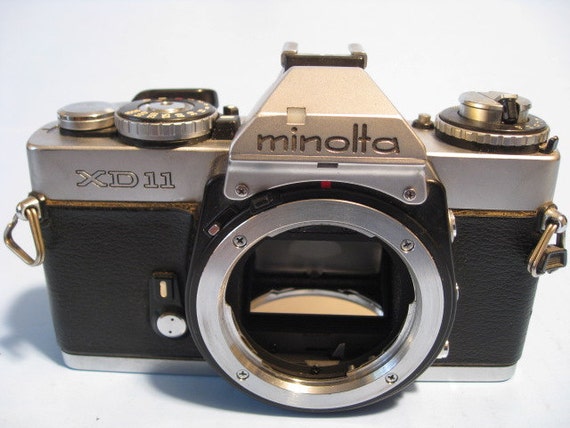
Find Your Meter & Serial Number. The Konica Minolta meter and serial application will help you quickly locate the meter reads and serial numbers on your equipment. Please use the product drop-down and select the model.

Serial Number Camera
On most cameras, mirror vibration is not a problem as long as speed is kept faster then 1/60 or so. A TLR has no mirror, so if you can hold it relatively steady you can bring the speed down as needed.The Autocord is well built and quite sturdy. I once dropped mine on concrete pavement. I had a bay 1- 49mm converter attached which absorbed the fall and took the beating – but the camera held it together and survived the fall well.ConsMany have reported that the focus lever can break easily if the overall focus has become stiff of old age. Recommendation: If your Autocord is hard to focus – bring it into to a shop to have it cleaned, lubricated and tuned (CLT).
Or, do it yourself if your feel capable (try the web for instructions). I have never had this problem on my Autocord.If you want more information. Hello Alexia,The Autocord uses a typical 120 film which is quite common. You can buy it in all pro photo stores and of course online. I once bought 100 expired Fuji Provia 120 films on Ebay for $200 – then put them in the freezer. I still have films left of that stock! Most of the pictures on Autocord.com are shot on that film.

Minolta Camera Model List
I’d recommend or for buying online. Of course you can also use B&W or a color negative. Personally I am moving into using more B&W and doing my own developing as I finish my stock of Provia.Hope you buy one – I’ve enjoyed mine 🙂Agust. I have a Minolta Autocord that has been in my family for many years. I believe it was my Grandpa’s camera, and somehow we ended up with it over the years. According to the link you gave above, it appears to be a Autocord LMX with Selenium Meter from the mid to late 1950s.
It’s in magnificent shape and appears to be working fine- although I have not yet tried it out.A friend of mine just bought a camera similar to mine, but a different make and model. We are both photographers, so I suggested we try out our cameras and see what we can come up with. Thanks to you for your site for giving me some background on these wonderful classics.Oh I was also shocked to find out how much these cameras are retailing for today– just shows the value in great machinery! Agust,That is a lovely review.
I have a very much used but perfectly functioning Autocord LMX. In the past I have used a 6×6 SLR and while it was of the highest quality and had the advantage of interchangeable lenses and so on, I absolutely detested the noise of the thing when I pressed the shutter release. It was like a rat trap. As you mention in your review there is no moving mirror in a TLR so the image is not interrupted during the exposure and there is also none of the noise that is associated with the mirror flying up and the back shutter opening in a SLR. One of the most enjoyable aspects of using a TLR is that the sound of the shutter is the only thing that one hears during the meditative process of making a photograph.